



 Ultra subscription.]
Every month, we review streaming data to understand where audiences spend their time. The rankings are always interesting, but September raised a more important question for me: Are we measuring creator reach in the right way? It’s no longer just about which platform a creator leads on. It’s about where viewers discover that creator, where they join the community, and how that relationship carries across platforms.
TheBurntPeanut generated 8.28 million hours watched on YouTube Gaming and another 8.10 million on Twitch, for about 16.4 million hours across platforms, more than any individual channel in the September rankings.
That distinction points to something bigger than a leaderboard position.
For most of live streaming’s history, we’ve defined creators by the platform they stream on: a Twitch streamer, a YouTube streamer, a Kick streamer. But that framing is becoming less useful, particularly when a creator’s audience spans several services.
The creator is increasingly the constant. Platforms are becoming different surfaces for discovery, engagement, and community. The next challenge is understanding what each surface does best without unnecessarily complicating the live experience.
Multiplatform distribution is maturing into multiplatform strategy
For a while now, the industry has been moving away from the question: “Where should I stream?”
The next iteration was: “How do I reach my audience wherever they choose to watch?”
I think we’re now entering a third phase: “How do I optimize each platform for the different audiences and behaviors that exist there?”
TikTok is a good example. It can be incredibly effective for discovery because the product is built around surfacing content to people who may have no existing relationship with the creator. Someone can encounter a live stream without ever searching for that creator or following them.
That makes TikTok valuable at the top of the funnel. It can introduce entirely new audiences to a creator. But discovery and community aren’t the same.
Platforms like Twitch focus more on persistent live communities. Chat behavior, subscriptions, emotes, recurring viewers, and the broader ecosystem of community interaction all give creators more tools to deepen that relationship over time.
YouTube can play a similar role differently. Live content can exist alongside long-form video, Shorts, memberships, search, and an established subscriber base.
So the opportunity is increasingly not just to simulcast the same experience everywhere; it is to understand the role each platform plays in the audience journey.
One platform may be where someone discovers you. Another may be where they become a regular viewer. Another may be where they consume highlights or catch up after missing a stream.
The strongest creator strategies will make those experiences reinforce one another rather than treating them as disconnected channels. That changes what multistreaming means.
A creator might use TikTok Live to maximize discovery, Twitch to foster deeper real-time interaction, YouTube to connect live content with searchable, evergreen video, and short-form content across multiple platforms to continually bring people back into the live experience. We’re still early in figuring out what the optimal version of that looks like.
For years, creators were encouraged to choose a platform and build their audience there. More recently, the industry has moved toward giving creators the freedom to distribute everywhere. The next phase will be helping creators understand how those platforms work together.
The biggest creators increasingly span platforms
TheBurntPeanut is an unusually clear example, but he isn’t the only one.
xQc generated 9.13 million hours watched on Twitch during September and another 2.75 million on Kick. Combined, that’s nearly 11.9 million hours watched across the two platforms.
This doesn’t mean platforms are becoming irrelevant. Each one still has its own audience, culture, discovery mechanisms, monetization systems, and strengths.
But creators increasingly have a reason to think about those platforms as parts of a larger ecosystem rather than mutually exclusive choices.
The most successful creators may not necessarily be the ones who build the largest audience on one service.
They may be the ones who get best at moving audiences through an ecosystem, using each platform for what it does best while keeping one coherent community around them.
Live audiences can move incredibly fast.
Another thing that stood out in September was how quickly the leaderboard changed.
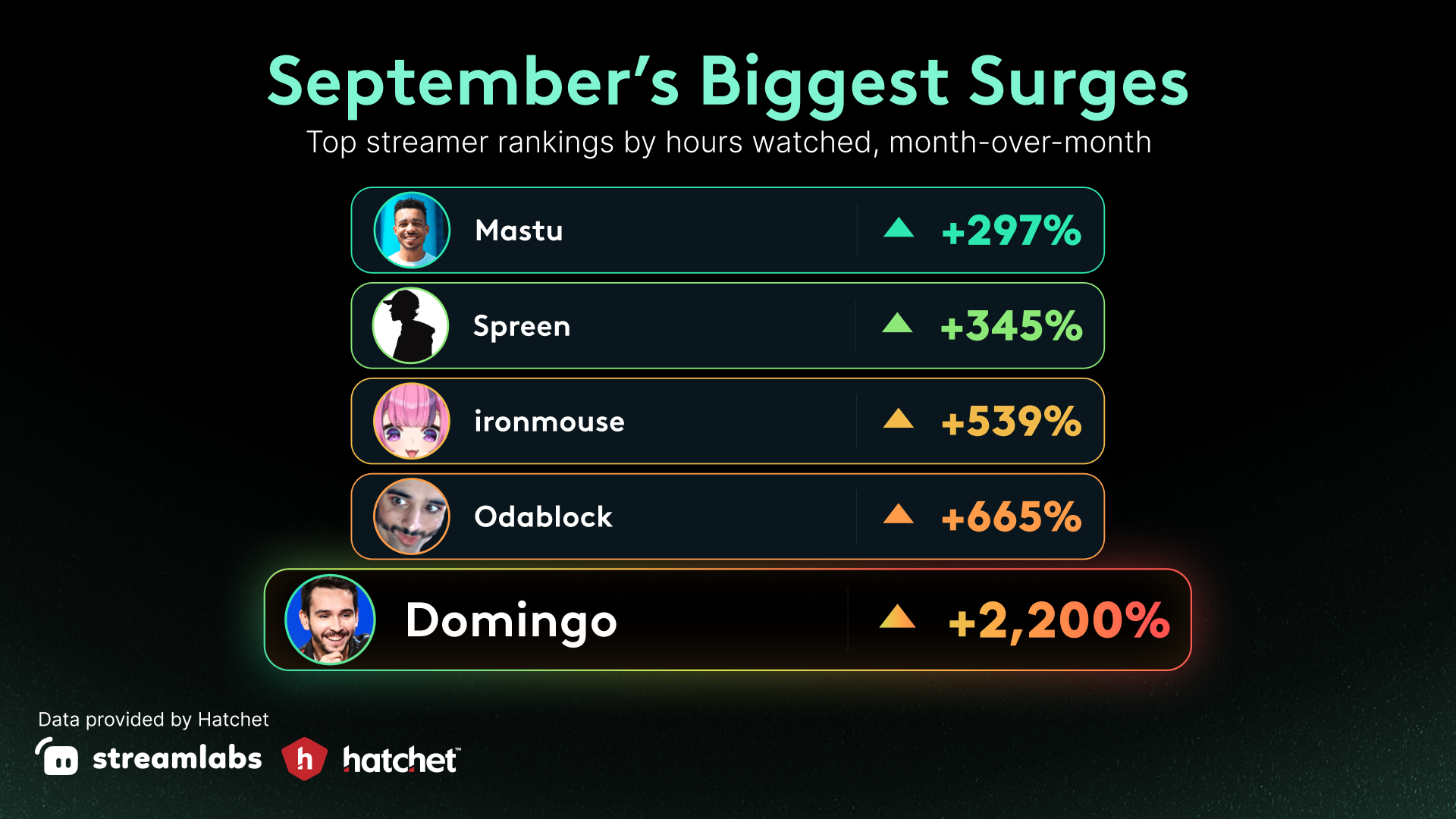
Odablock increased hours watched 665% month over month. Ironmouse grew 539%. Spreen increased 345%. Mastu grew 297%. Domingo jumped more than 2,200%.
Those numbers are extreme, but the underlying behavior is familiar to anyone who follows live content closely.
Within weeks, the live-streaming audience can look completely different. A new game launches. A tournament begins. A creator becomes part of a cultural moment. A major event suddenly captures enormous attention.
Some treat that volatility as a challenge for live streaming. I think it’s one of its strengths.
Live content is responsive in a way most media isn’t. Creators can react immediately to what audiences care about, and audiences can reorganize themselves around a new game, creator, or moment almost overnight. It also makes the multiplatform opportunity more important.
When audience attention can shift this quickly, creators benefit from having multiple ways to participate in those moments and multiple surfaces through which new viewers can discover them.
We need to start thinking about creator reach differently
Taken together, these trends point toward a broader change.
Audiences are becoming more distributed across platforms while also moving more quickly between creators and content. That has implications for everyone building in this space.
For creators, distribution is only the beginning. The bigger opportunity is understanding each platform's strengths and building an audience strategy around them.
For platforms, creator-friendly distribution, interoperability, and differentiated community experiences become increasingly important.
And for companies like Streamlabs, the challenge is helping creators manage that complexity without forcing them to treat every platform as a completely separate workflow.
The industry will obviously keep tracking Twitch versus YouTube versus Kick. Those numbers still matter. But the questions September’s data raises go beyond which platform or creator finished first:
- Where does a creator get discovered?
- Where does a casual viewer become part of the community?
- How does the creator maintain that relationship across different platforms and formats?
- And how easily can they optimize each surface without multiplying the complexity of going live?
September’s data gives us a preview of where this is heading. The creator increasingly sits at the center of the ecosystem, and the real measure of reach may be how effectively they turn cross-platform discovery into lasting community. The rankings tell us where viewers spent time. These questions help us understand how creators can use that attention.